The Transactional
Firewall for
AI Agents
Build reliable, production-ready AI agents in 5 lines of code. Stop LLM hallucinations from corrupting your state with automated rollbacks and invariants.
 Trusted by developers worldwide
The Problem with Agent Memory
If you don't validate state, one hallucination will corrupt your entire workflow.
The Problem
Agents are probabilistic. Even the best models eventually output bad JSON or take illegal actions (like booking a negative number of hotel days). Native checkpointers blindly save this corrupted state to your database, permanently breaking the graph.
The StateGuard Solution
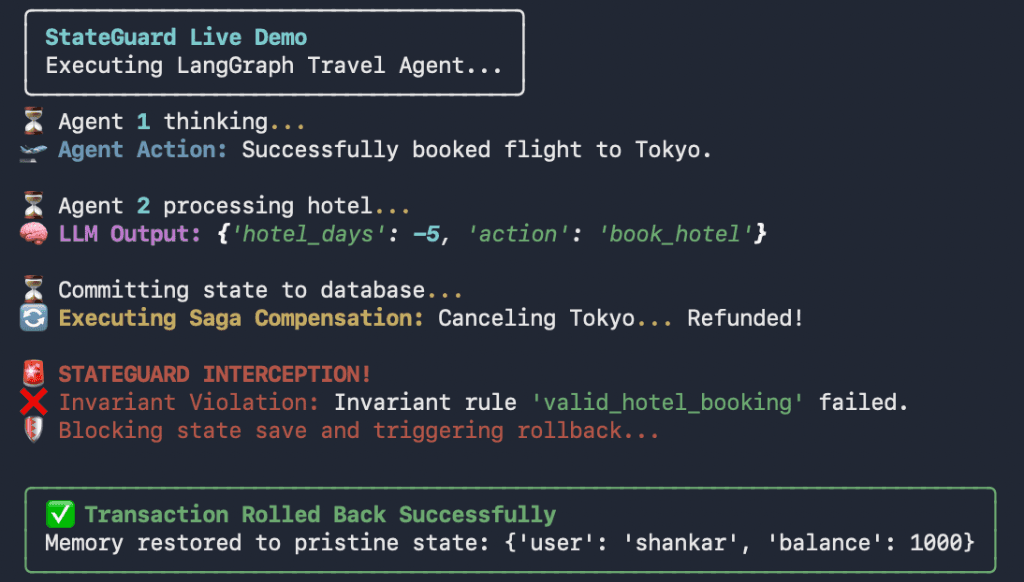
StateGuard acts as a firewall. It intercepts the memory save. If a business rule fails, it blocks the database write, safely rolls the memory back to the last pristine state, and automatically executes Saga compensations (like refunding a Stripe charge) to clean up real-world side effects.
We don't replace your memory.
We put a bulletproof vest on it.
StateGuard requires zero refactoring. It is not a new framework that forces you to rewrite your logic. Simply wrap your existing Python dictionaries or drop us in as your LangGraph checkpointer.
The 60-Second Cookbook
Integrate StateGuard into your stack instantly.
Visualizing the Intercept
Watch how StateGuard catches hallucinations before they hit the database.
Robust State Management
Stop treating your LLM agent memory like a plain text file.
TypeScript for your Agent's Memory
Define strict rules (invariants) for your agent's state. If a generation violates a rule, StateGuard blocks it instantly.
Database Transactions for AI
Wrap LangGraph nodes in transactional blocks. Either the entire multi-step process succeeds, or the state safely rolls back.
An Undo Button for API Calls
Automatically trigger rollback logic to undo side-effects (like refunding a Stripe charge) when an agent hallucinates.
Works with your stack
Drop-in compatibility with the most popular multi-agent frameworks.
LangGraph
Replace MemorySaver in 2 lines.
CrewAI
Secure crew Task outputs.
Vanilla Python
Wrap raw dicts in while-loops.
AutoGen
Native integration coming soon.
"Doesn't LangGraph already do this?"
LangGraph Native Memory
- Saves corrupted data permanently.
- Manual rollbacks required.
StateGuard Memory
- Blocks corrupted data instantly.
- Automated API rollbacks via Sagas.
Frequently Asked Questions
Everything you need to know before putting StateGuard into production.
Does this add latency to my LLM calls?
Do I need to rewrite my LangGraph code?
MemorySaver or SqliteSaver. You only need to change 2 lines of code.